Visual guide
The ADHD Iceberg
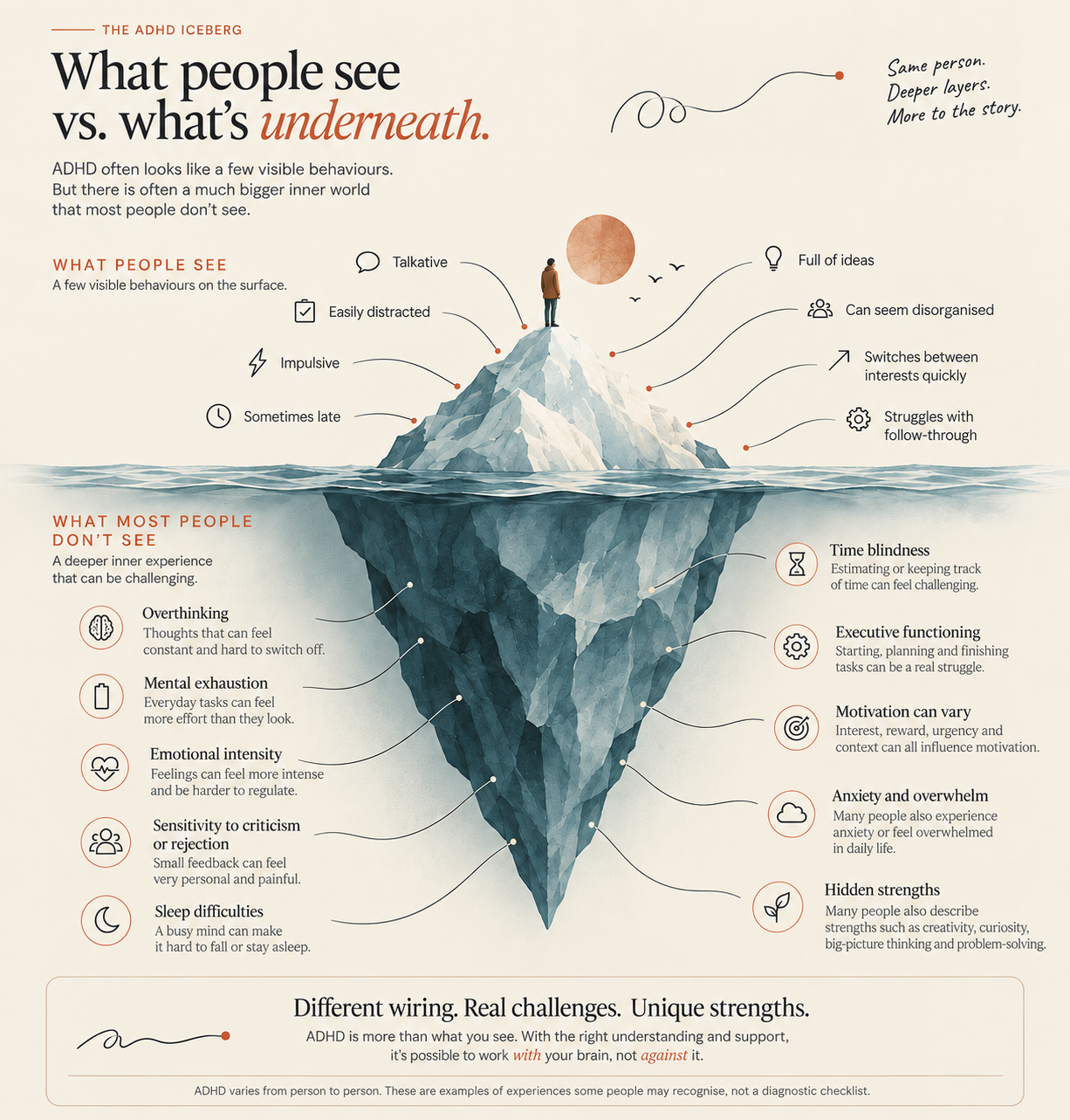
ADHD is often understood through the behaviours people can see. But the same outward behaviour can have many different explanations, and some of the experiences associated with ADHD may be much less visible.
 (opens full-size image in a new tab)
Text version
What people see vs. what’s underneath.
ADHD often looks like a few visible behaviours. But there is often a much bigger inner world that most people don’t see.
Same person. Deeper layers. More to the story.
What people may see
A few visible behaviours on the surface.
- Talkative
- Easily distracted
- Impulsive
- Sometimes late
- Full of ideas
- Can seem disorganised
- Switches between interests quickly
- Struggles with follow-through
What people may not see
A deeper inner experience that can be challenging.
- Overthinking
- Thoughts that can feel constant and hard to switch off.
- Mental exhaustion
- Everyday tasks can feel more effort than they look.
- Emotional intensity
- Feelings can feel more intense and be harder to regulate.
- Sensitivity to criticism or rejection
- Small feedback can feel very personal and painful.
- Sleep difficulties
- A busy mind can make it hard to fall or stay asleep.
- Time blindness
- Estimating or keeping track of time can feel challenging.
- Executive functioning
- Starting, planning and finishing tasks can be a real struggle.
- Motivation can vary
- Interest, reward, urgency and context can all influence motivation.
- Anxiety and overwhelm
- Many people also experience anxiety or feel overwhelmed in daily life.
- Hidden strengths
- Many people also describe strengths such as creativity, curiosity, big-picture thinking and problem-solving.
Different wiring. Real challenges. Unique strengths.
ADHD is more than what you see. With the right understanding and support, it’s possible to work with your brain, not against it.
ADHD varies from person to person. These are examples of experiences some people may recognise, not a diagnostic checklist.
ADHD can look different for everyone.
ADHD varies from person to person, and not everyone will recognise every experience shown here.
Visible behaviours don’t necessarily tell us what someone is experiencing underneath. Two people can look much the same from the outside and be dealing with very different things.
This guide is meant to encourage curiosity and understanding, not diagnosis. If something here resonates, it may simply be a useful place to start a conversation.
This visual guide is for educational purposes only. It is not a diagnostic checklist and is not a substitute for medical advice, diagnosis or treatment.
Back to ResourcesYou don’t need to have everything figured out before we talk.
A free 30-minute conversation is simply a chance to meet, talk about what’s happening for you, and see whether coaching feels like the right next step.
Book a Free 30-Minute Conversation (opens in a new tab)